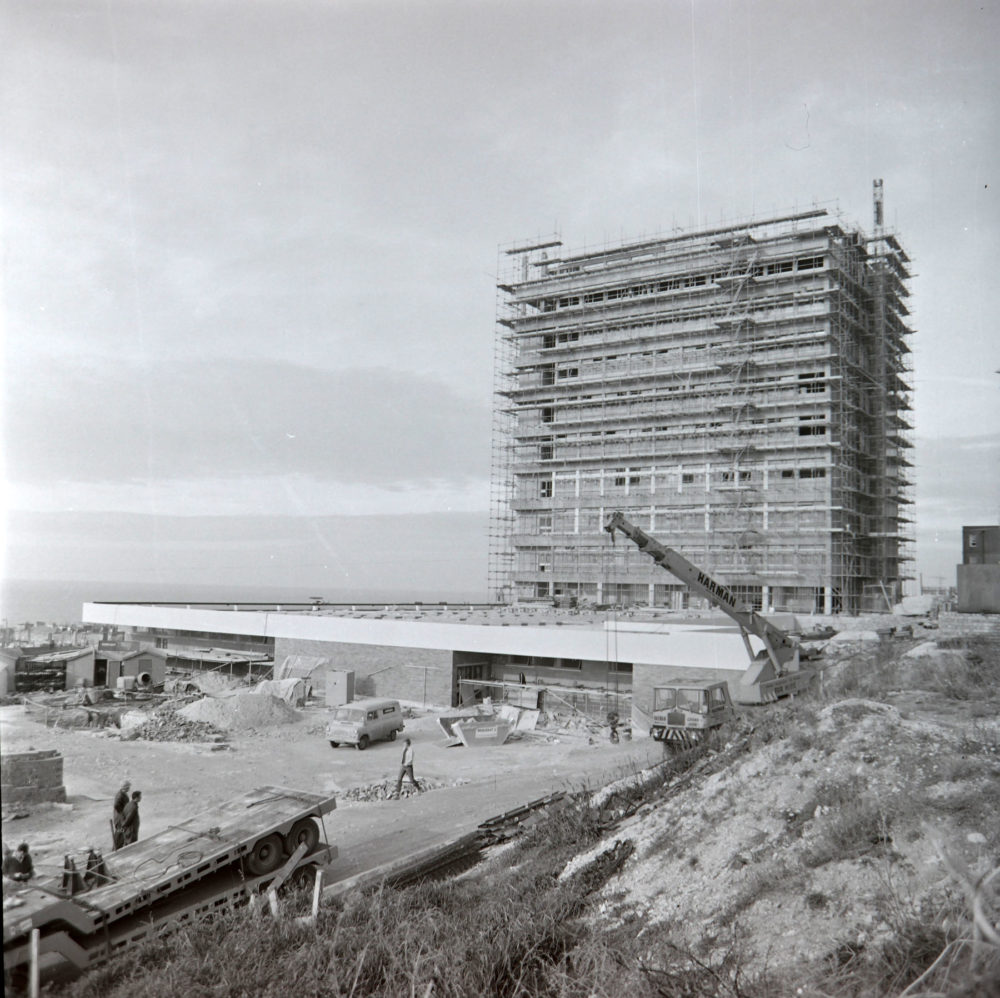
Thomas Kemp Tower under construction, circa 1968
The Thomas Kemp Tower was designed 1964-1965, with building works starting shortly after. Until the new hospital development, the Thomas Kemp Tower housed the on-site pharmacy (level 3), in-patient MRI (level 4), all units associated with Accident & Emergencies on level 5, Frontier Pathology (level 6), Critical Care (level 7), the Vascular Assessment Unit and Ward (level 8), Endoscopy and Digestive Diseases Outpatients (level 9), the Albion and Lewes Ward (level 10), the Antenatal, Early Pregnancy and Gynaecology Units and Ward (level 11), the Maternity – Postnatal and Antenatal Wards (level 12), the Maternity – Labour Ward (level 13), and the Trevor Mann Baby Unit (level 14).
Image courtesy of Brighton & Sussex University Hospitals NHS Trust.
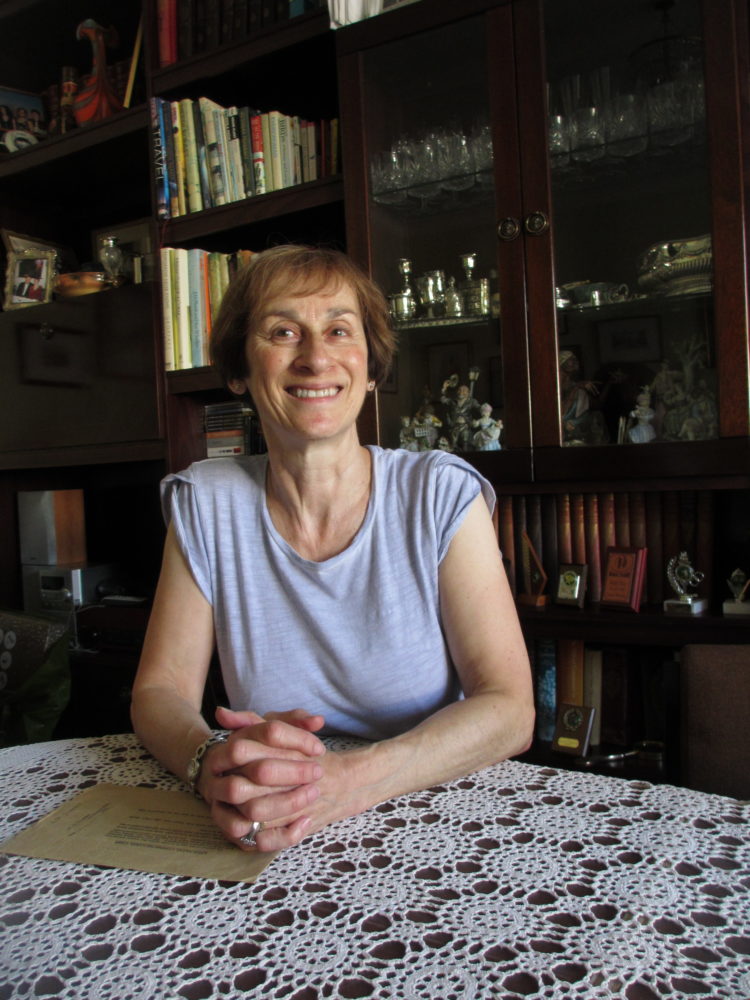
Ruth Simmons
Ruth Simmons (born 1954) gave birth at the Royal Sussex County Hospital in 1980, and talks about the days leading up to the birth of her second child, and her stay at the hospital. Including a description of prenatal care, her experiences during labour, and what it was like staying at the hospital. Plus the difference in the amount of paperwork you had to do and the relative lack of choices in comparison with the present day. Ruth is now a volunteer at the hospital, and describes what that means to her.
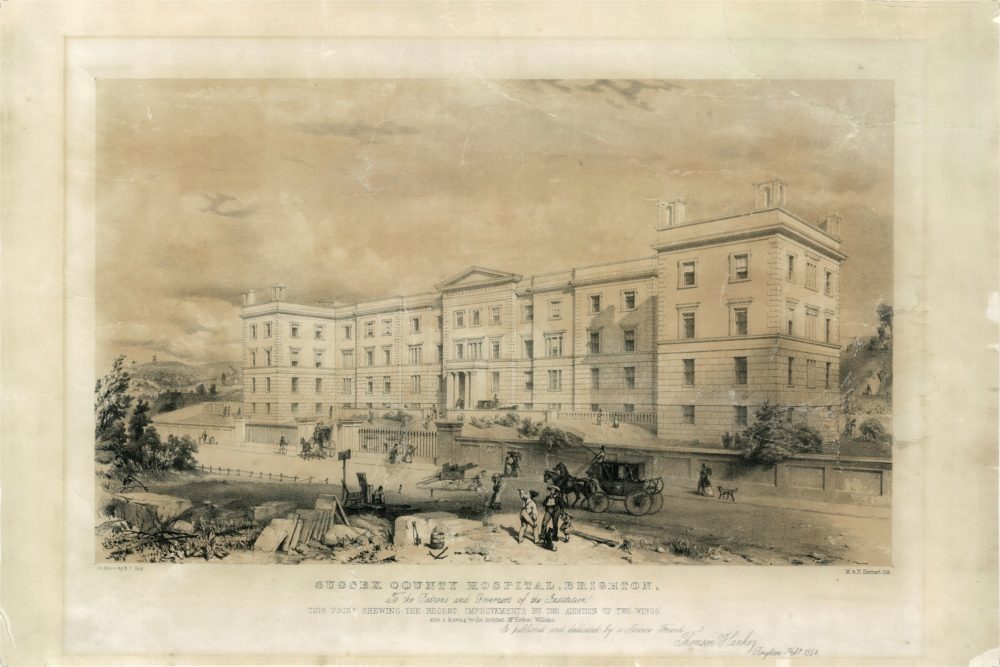
Sussex County Hospital, 1854
Illustration taken from an architectural drawing by Mr Herbert Williams in 1854 to celebrate the addition of the east and west wings to the (Royal) Sussex County Hospital, completed in 1853.
Inpatients rose from 604 in 1834 to 1,065 in 1851, which prompted the development of additional wings. An appeal for funding raised £4,300, with the greatest donations coming from the Marquis of Bristol and William Catt. Herbert Williams (designer of the Adelaide Wing) was appointed architect and drew up plans for large extensions at the east and west ends of the hospital.
At the west end a sizeable extension included a large ward twice the size of the Victoria Wing, which was named for the Marquis of Bristol. There were also new bathrooms and lavatories installed. The foundation stone was laid by Lady Jane Peel on 21 September 1852. At the east end the Fever Ward was extended and linked into the main building. These buildings contained several characteristics similar to the original building and reinforced the symmetrical nature of the hospital from the south.
Image courtesy of Brighton & Sussex University Hospitals NHS Trust.
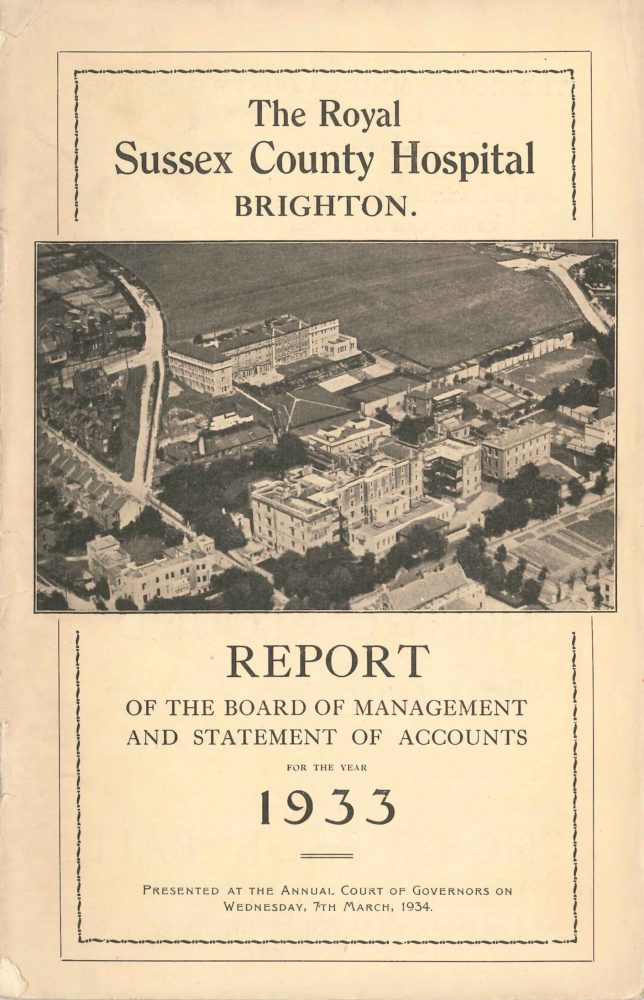
Royal Sussex County Hospital (aerial view), 1933
A photograph of Royal Sussex County Hospital from the air, used for the cover of 1933 Report of the Board of Management and Statement of Accounts.
The image shows the ongoing developments growing around the hospital, which include residential and additions to the hospital itself. This includes the Jubilee Block (east of the Barry Building), constructed in 1887, which was originally built to be a sanatorium.
To the south east of the Barry Building exist empty fields, where the Sussex Eye Hospital was later built. During World War I the fields were used as allotments to grow and provide food to Brighton.
Image courtesy of Brighton & Sussex University Hospitals NHS Trust.
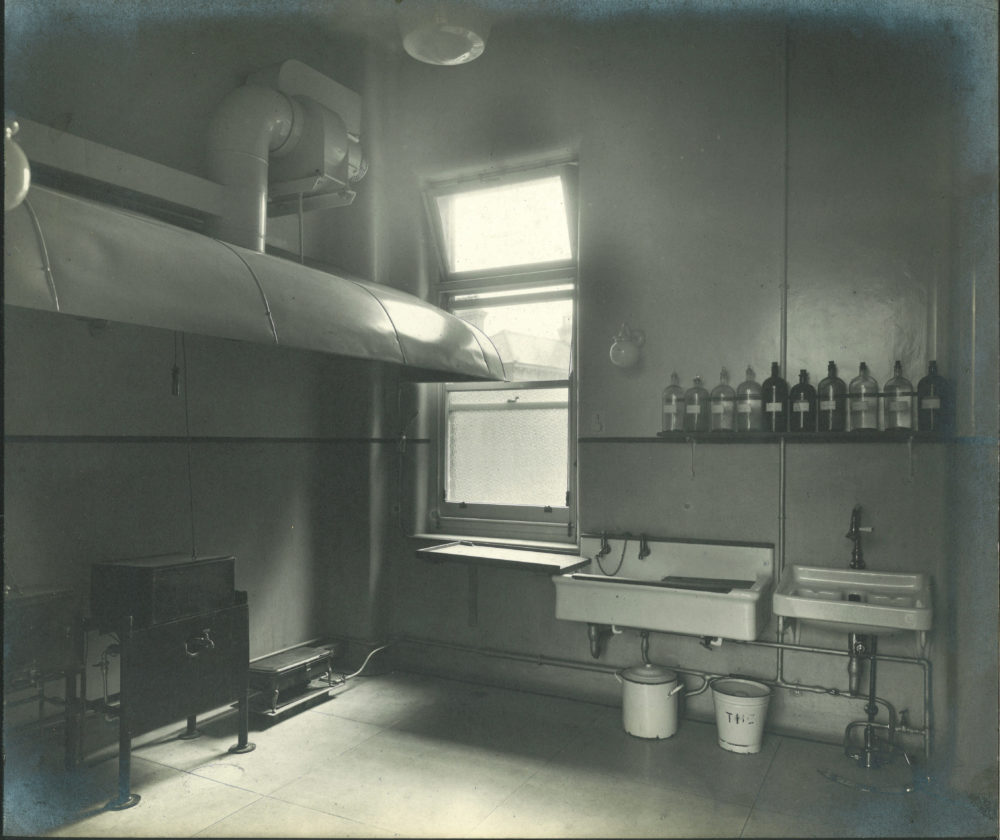
Utility room, Royal Alexandra Hospital, c. 1910
A utility room at the Royal Alexandra Hospital, which is now part of Royal Sussex County Hospital. Cleaning materials and equipment are shown, giving an idea of how hospitals and hospital equipment was cleaned and sterilised at the time. (c, 1910). The labels on the row of bottles for chemicals and cleaning fluids on the shelf cannot be read, but they would have included carbolic acid and bleach derivatives. Steam sterilisation was introduced in the late 19th century and gradually became widely used for surgical instruments.
Image courtesy of Brighton & Sussex University Hospitals NHS Trust.
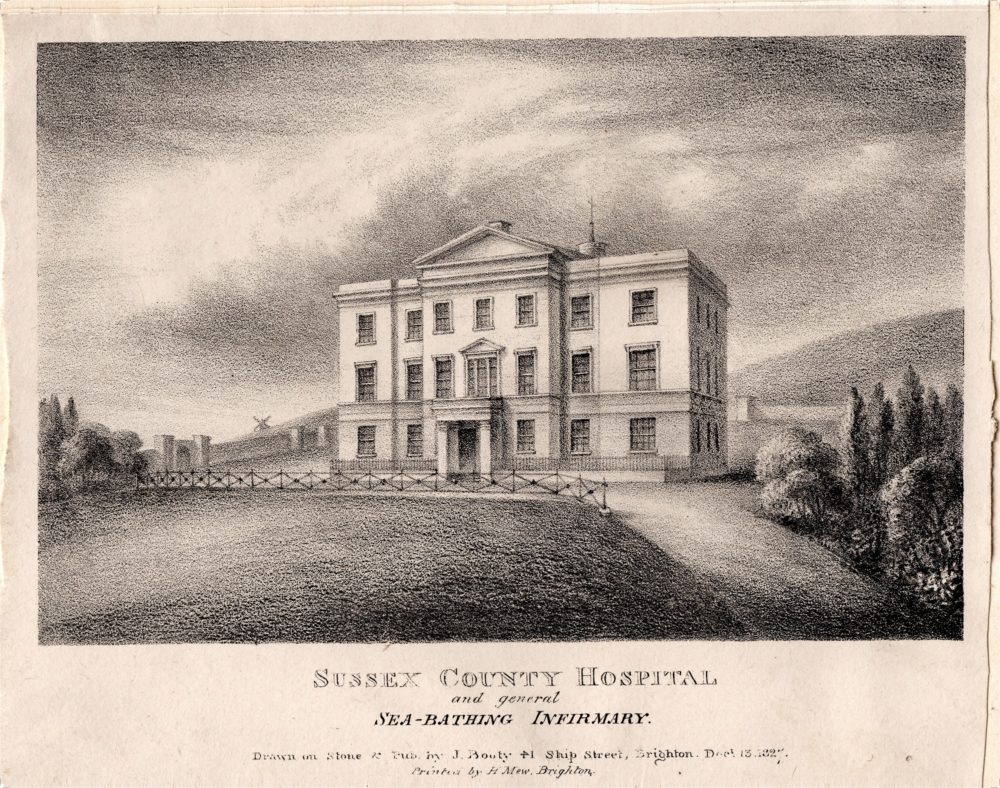
Sussex County Hospital and Sea-Bathing Infirmary, 1827
Drawn by J. Bouty in 1827, this print was made prior to the Sussex County Hospital’s opening in 1828. It shows the hospital’s Barry Building in its original condition.
A ‘Sea-Bathing Infirmary’ for Brighton was founded in 1824, with land being provided by Thomas Kemp and designs by Sir Charles Barry. Money was raised by subscription and a tender drawn up using Barry’s most basic design, with the total cost of boundary walls, a well, a new road to the sea (Paston Place) and the building itself coming to over £14,000. It was a rather plain Regency-style building of four storeys, based on a domestic scale and design style. At the time of its construction it was the only structure on the north side of Eastern Road in the area, and was set upon a hill. Soon after its opening the hospital was changed to the Sussex County Hospital and lost most of its associations with sea-bathing.
Image courtesy of the Regency Society and Brighton & Sussex University Hospitals NHS Trust.
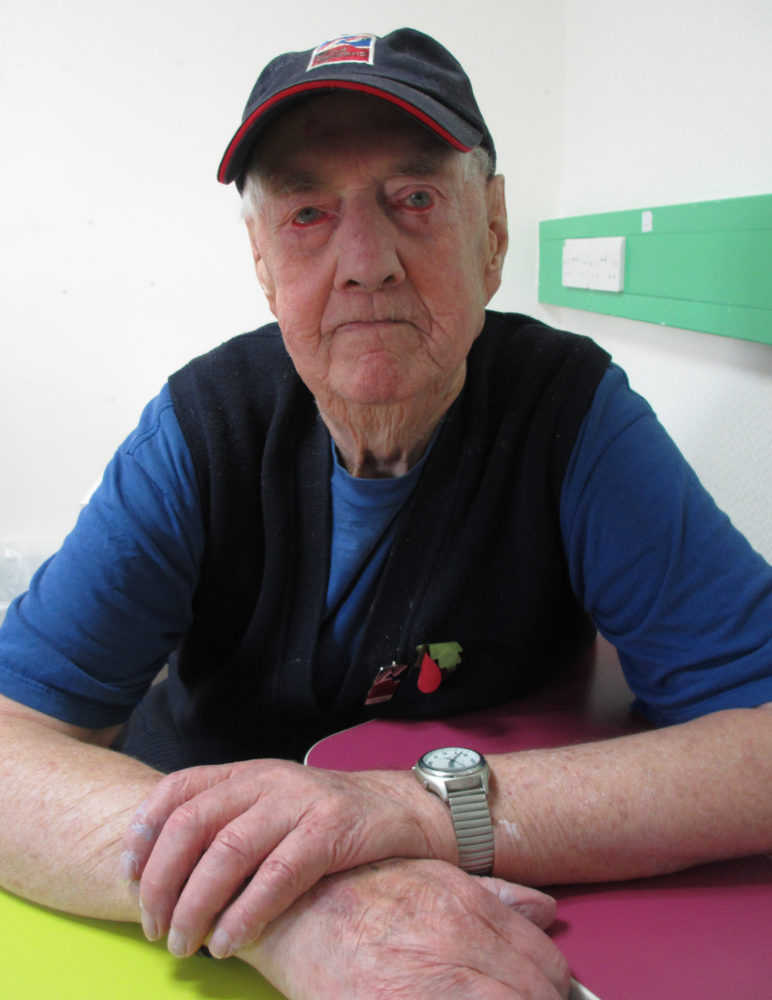
Peter Saunter
Peter Saunter started working at Royal Sussex County Hospital at the age of 57. His wife also came to work there for a period, when she was volunteering for the WRVS (the Royal Voluntary Service welfare branch). The camaraderie between the porters, and between the porters and other staff, from nurses to surgeons, are key themes in Peter’s interview. Several memories describe funny incidents involving staff and porters, and in one, Peter talks about a patient who laughed so hard they fell out of bed.
Peter had a telescope that his colleagues, even surgeons, used to survey the surrounding area. He describes how consultants and surgeons looked after the other staff as well as their patients – on one occasion, a surgeon diagnosed a surgery that Peter needed while busy with a patient, and consultants were generally very kind to staff when they were ill.
In 1984, at the time of the Brighton bombings, Peter ran the crew of porters. Afterwards, he received a letter from Margaret Thatcher thanking him for what he did during the bombing incident.
Peter’s only complaints was about the food, which he says was not very nice – if he were in charge, this is the first thing he would change.
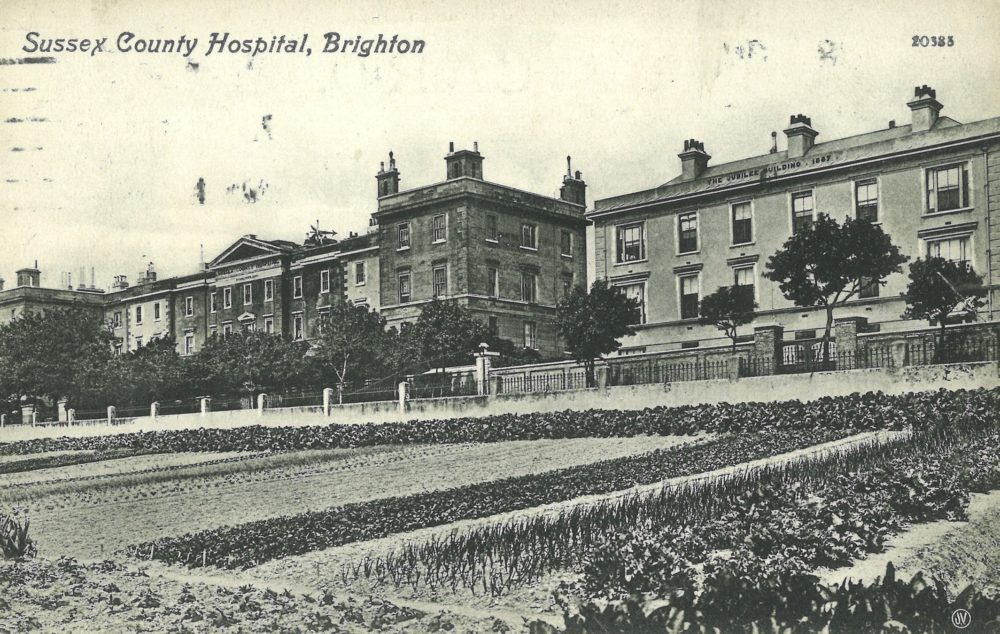
Royal Sussex County Hospital, circa 1914
Postcard photo of Royal Sussex County Hospital taken from the south east (circa 1914), overlooking the field in front of the hospital before it was built upon. This land was originally purchased by the hospital to retain an open area of space.
During World War I the field became allotments where food was grown for the local area. Eventually the land was used to expand the hospital, becoming the site of Sussex Eye Hospital (one of local architect John Leopold Denman’s Neo-Georgian buildings), which opened in 1935.
Image courtesy of Brighton & Sussex University Hospitals NHS Trust.
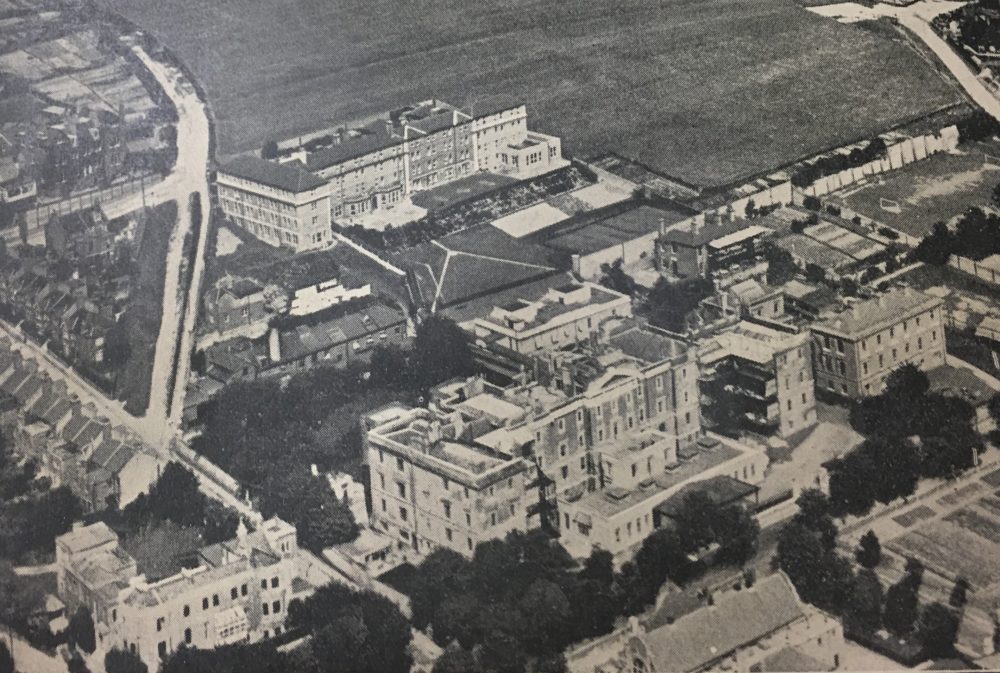
1960s aerial view, Royal Sussex County Hospital
This aerial view shows how the original, symmetric layout of the hospital had expanded into a clutter of buildings and extensions in the 1960s. The Thomas Kemp tower was completed in 1969 and does not show in this photograph, where the skyline of the hospital remains level with the original Barry building.
Image courtesy of Brighton & Sussex University Hospitals NHS Trust.
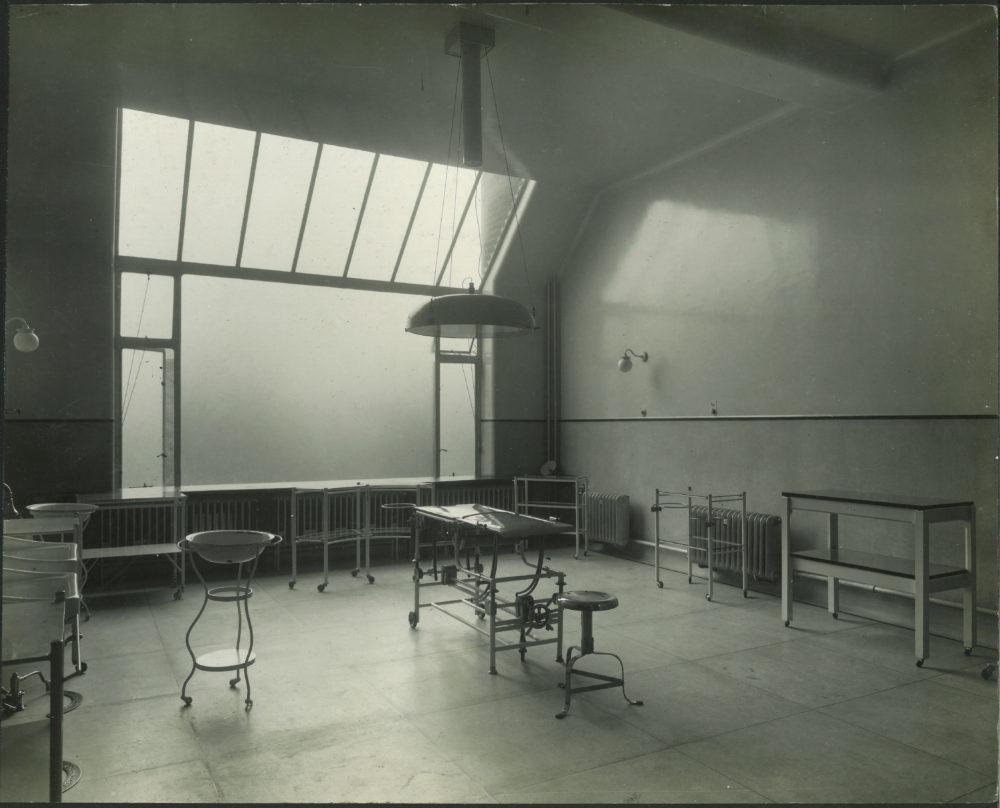
Surgical theatre, c. 1910
Photograph of an empty surgical theatre at the Royal Alexandra Hospital, now part of Royal Sussex County Hospital, c. 1910. The large windows emphasise the role that sunlight played in good hospital care at the time. The bare surfaces we see on simple frames with coasters – so that they could be moved as needed – allowed for sterilisation.
Here, as well as in many other photos from the time, we see the value placed on air and sunlight for infection control.
Image courtesy of Brighton & Sussex University Hospitals NHS Trust.
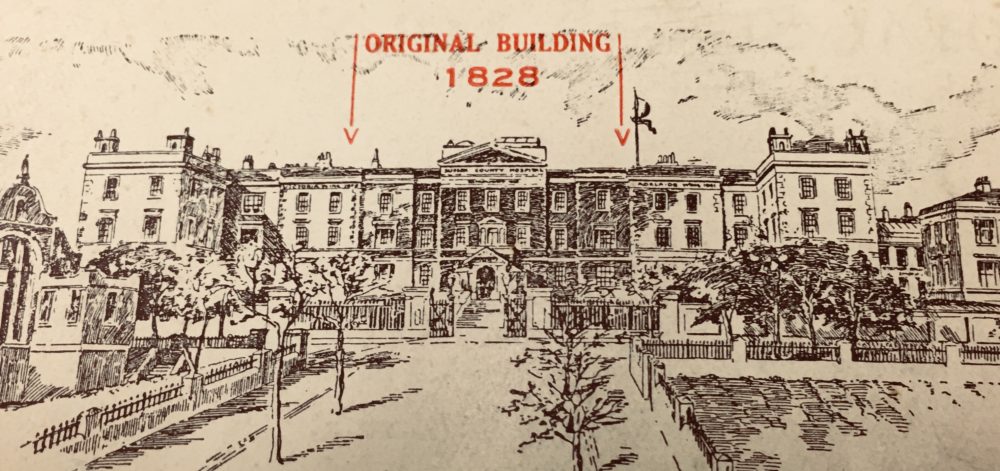
Illustration of Royal Sussex County Hospital, circa 1854
A drawing of Royal Sussex County Hospital, circa 1854, which points out the original structure of the Barry Building, which was opened in 1828.
The image shows the developments to the wings and subsequent extensions, including Victoria Wing in 1839 and Adelaide Wing in 1841, and further east and west wing extensions completed in 1853.
When the hospital was first built, there were beds for 80 patients. This was not a measure of how many people needed healthcare at the time, and the hospital continued to always need more beds than it had. Its expansion continued with the Jubilee Building in 1887, and many more since.
Image courtesy of Brighton & Sussex University Hospitals NHS Trust.
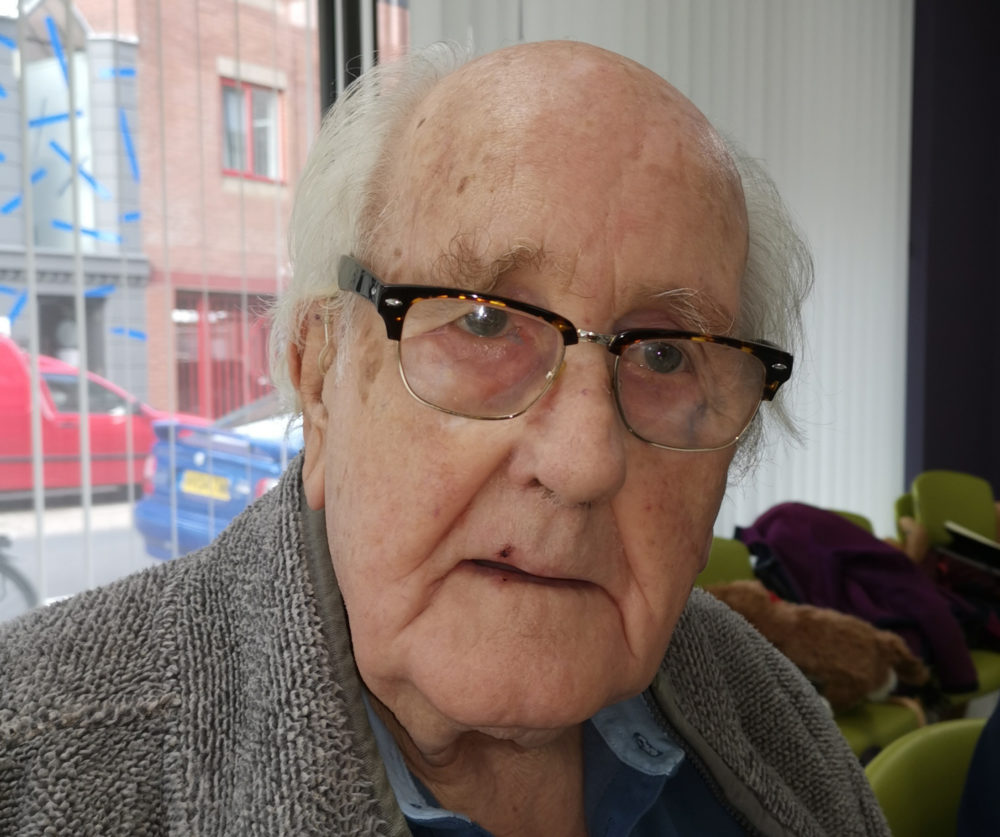
Ted Knight
Ted Knight (born 1933) worked for Brighton Corporation Water Works for 42 years, with Royal Sussex County Hospital being one of his main sites. Ted also attended the hospital as a patient on three occasions; for a back injury and kidney troubles in the 1960s, and for an eye injury in the 1970s. He speaks very highly of the care and RSCH nurses in his interview.
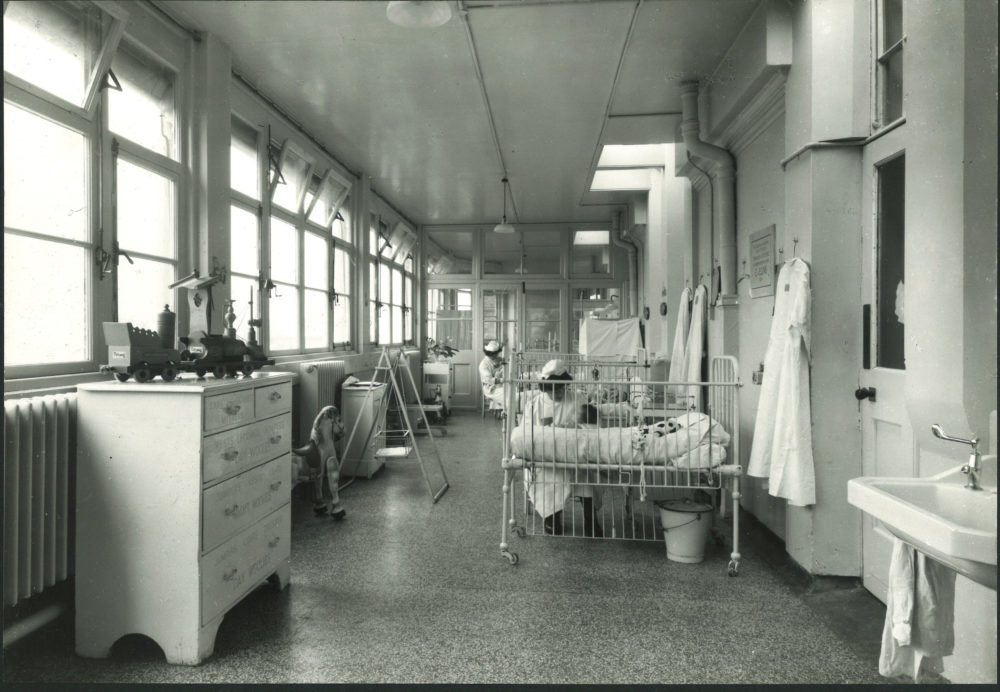
Paediatric ward, Royal Alexandra Hospital
This photograph of a paediatric ward at the Royal Alexandra Hospital, which is now a part of the Royal Sussex County Hospital, shows a row of cots exposed to sunlight from a row of large windows, a chest of drawers with wooden toys, and a nurse in the distance. The photo is taken in the inter-war period, before the discovery of penicillin, and sunlight was an important part of fighting tuberculosis and other infectious diseases.
Image courtesy of Brighton & Sussex University Hospitals NHS Trust.
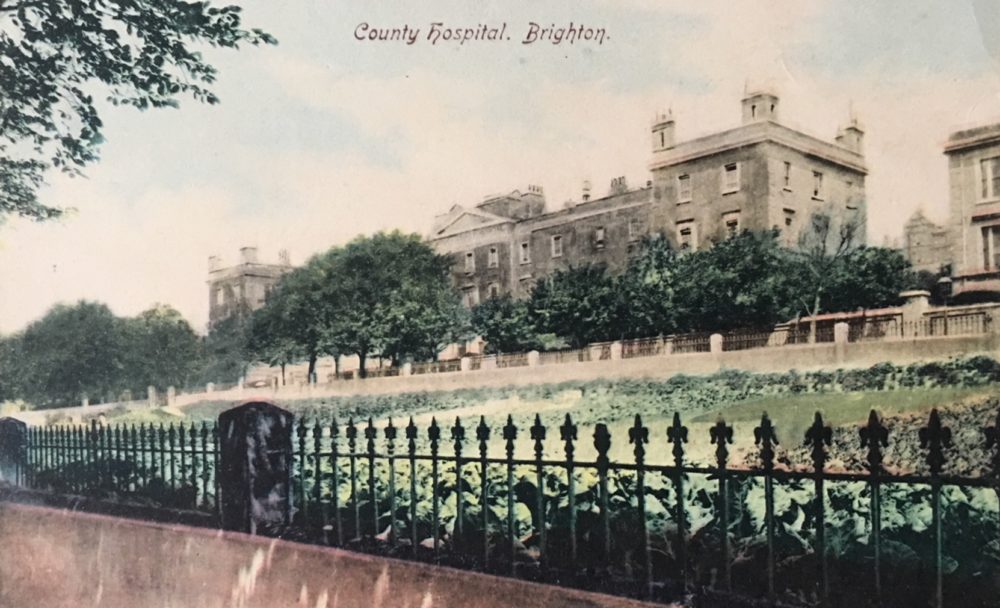
Colourised postcard, Royal Sussex County Hospital
A colourised postcard with an oblique view of the Royal Sussex County Hospital as it looked in the early 20th century. Here, the grounds and the shape of the original Barry Building and its two wings are clear to see, reflecting the vision of order and symmetry that guided its architects. At this time, the brick facade of the building is not rendered in stucco.
Image courtesy of Brighton & Sussex University Hospitals NHS Trust.
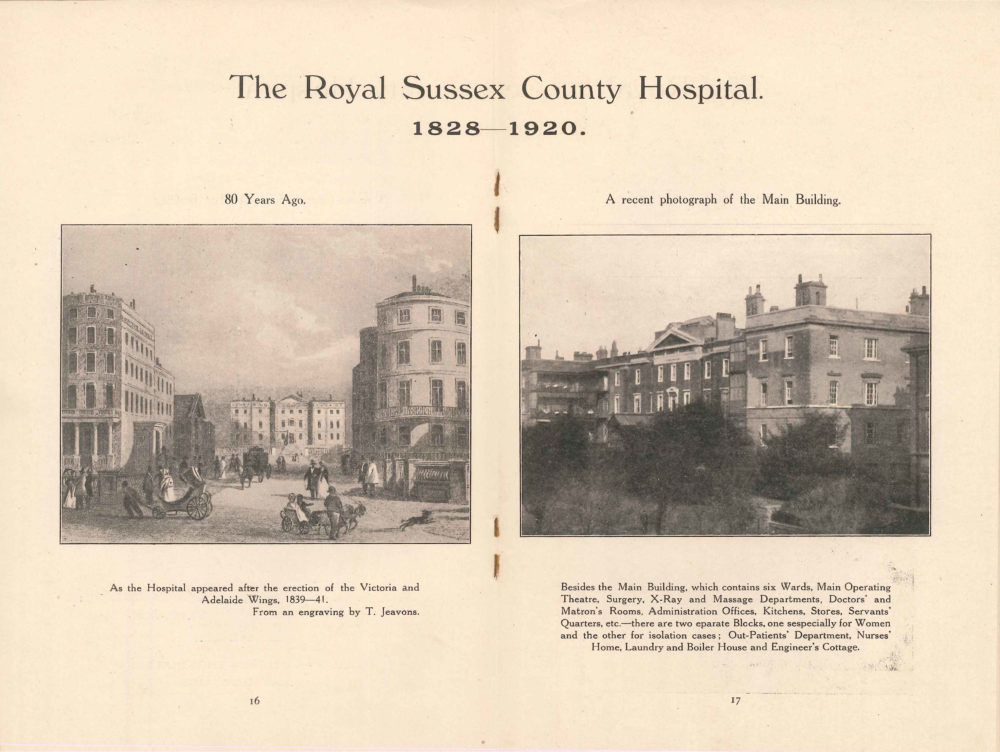
Royal Sussex County Hospital, 1828-1920
Photographs in a 1920s brochure, with a side-by-side comparison of the view of the initial hospital building as it was seen from the bottom of Paston Place in 1828 with an external view of the hospital building with its two wing extensions in 1920. These images mark a period in history during which enormous social and scientific change took place. When the hospital was first opened in 1828, Brighton was the fastest-growing town in the UK – its population had increased tenfold in four decades. George, Prince of Wales, bought the first property at the site of the Pavilion in 1786, making the already popular sea-bathing resort a key destination for the fashionable set.
Initially called the Sussex County Hospital and General Sea-Bathing Infirmary, the first hospital was built as a beautiful neoclassical building in parkland, giving the impression of order and stability, or even a grand country house. The architect Charles Barry’s Palazzo style can also be seen in the London clubs he designed and in 1840, he designed the Palace of Westminster in Gothic Revival style, for the House of Commons and House of Lords.
The century that separates these two images saw great social change. When it was built, poverty was regarded as an inescapable fact of life and a hundred years later, although there was still significant poverty among Brighton’s precariously employed and unemployed classes, political organisation challenged ideas of ‘deserving’ and ‘undeserving poor’ that were dominant when the hospital opened. The processes of change that gained momentum in the inter-war years came to fruition after WW2, when we saw the foundation of the NHS.
Image courtesy of Brighton & Sussex University Hospitals NHS Trust.
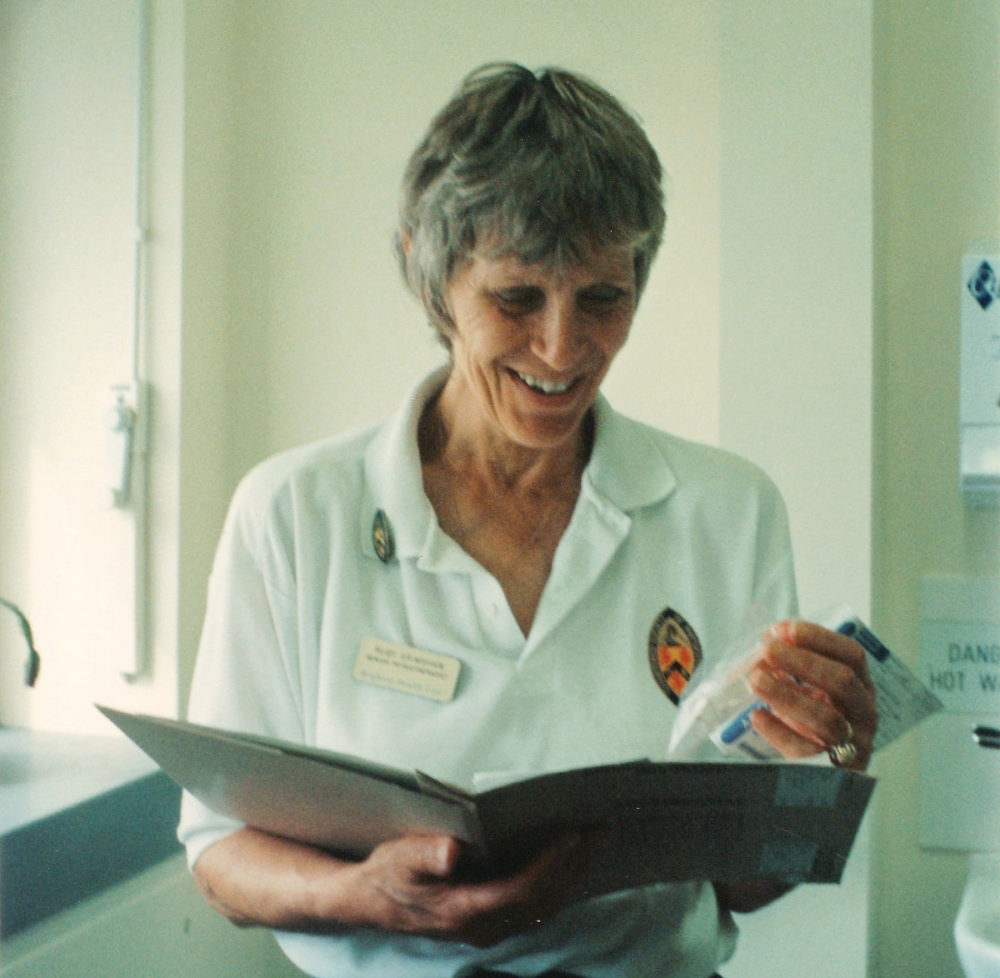
Ruby Grimshaw (in two parts)
Ruby Grimshaw (born 1939) worked as a Physiotherapist and later Superintendent Physiotherapist at Royal Sussex County Hospital 1962-2004. During this period, she also worked in Switzerland and Hong Kong, and ran antenatal classes until the cuts to services in the 1990s. Her interview is rich in detail of her work experience, differences and developments in treatment during her career, reflections on what her work meant to her, and the difference in how physiotherapists are trained then and now.
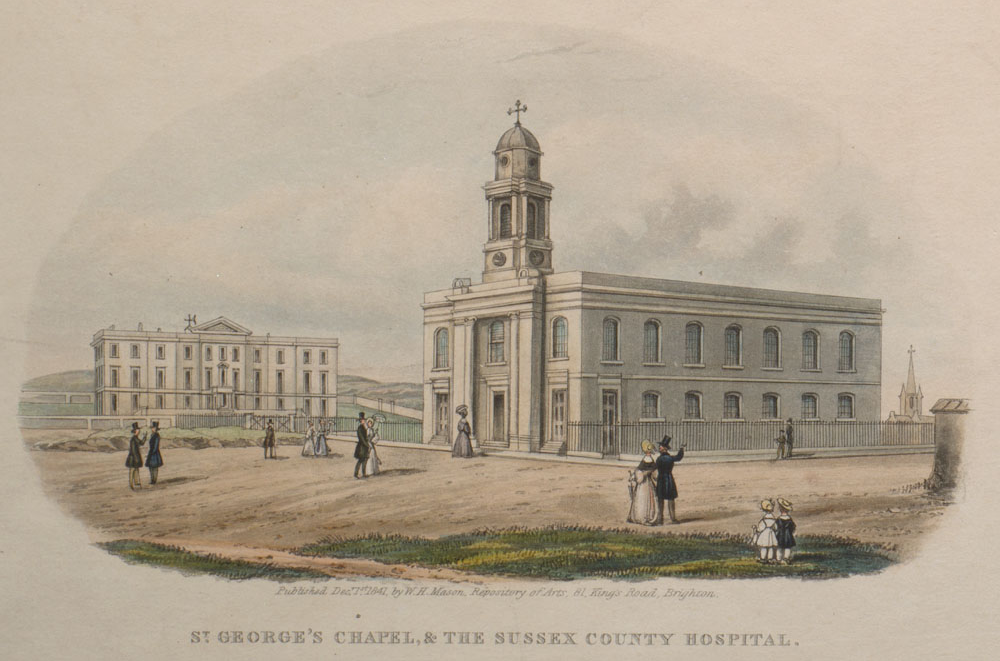
St George’s Chapel & the Sussex County Hospital, 1841
Artist’s rendition of the Royal Sussex County Hospital and St George’s Chapel, prior to the establishment of the street grid on either side of the present Abbey Road, between Eastern Road and St George’s Road. The two Regency neo-classicist buildings, set in what was then open land, reflect the social and architectural vision of the new developments.
Image courtesy of Brighton & Sussex University Hospitals NHS Trust.